The Reset Consumer: Understanding the New Psychology of Choice
Masterclass
22-05-2026
The Reset Consumer: Understanding the New Psychology of Choice
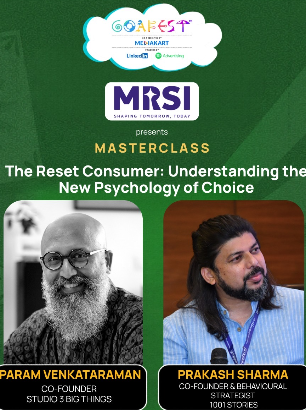
22nd May, 2026: Mumbai, India: At GoaFest 2026, the Market Research Society of India (MRSI) hosted a masterclass titled ‘The Reset Consumer: Understanding the New Psychology of Choice’ featuring Param Venkataraman, Co-founder, 3 Big Things, and Prakash Sharma, Behavioural Strategist and Co-Founder, 1001 Stories. The session explored how consumer decisions today are increasingly shaped not just by information, but by context, emotional triggers, and the structure of choices presented to them.
The speakers explained that while core human instincts such as fear, desire, safety-seeking, aspiration, and social influence remain constant, the environment in which consumers make decisions is constantly evolving. Changes in technology, accessibility, economic conditions, convenience ecosystems, and social behaviour continue to reshape how people interpret value, trust, urgency, and action.
They noted that consumer hesitation is often caused not by lack of awareness, but by “false dilemmas," where both available choices feel difficult, uncertain, or suboptimal. In such situations, consumers tend to delay decisions, seek repeated validation, look for alternate pathways, or avoid making a choice altogether.
Prakash Sharma explained that decision-making is deeply influenced by behavioural context and mental framing. Through examples from everyday consumer behaviour, he demonstrated how perception changes based on anchors, comparison points, social influence, and emotional cues rather than pure logic. He highlighted that consumers often simplify complex choices by looking for what feels safer, more relatable, or psychologically easier to justify.
Using examples around consumption behaviour, he illustrated how the structure of options itself can influence decision outcomes. Introducing a middle option, changing comparison points, or reframing value can shift consumer preference without forcing behaviour. He explained that the brain constantly searches for cues that reduce uncertainty and make choices feel safer or more acceptable.
The session also explored how consumers assign emotional meaning to money and value. Sharma spoke about “mental accounting," where people treat money differently based on how it is received or experienced. He noted that consumers often behave differently with digital payments, refunds, incentives, or earned income because emotional perception influences spending behaviour as much as financial logic.
Param Venkataraman expanded on this through healthcare behaviour examples. He explained that patients diagnosed with serious illnesses often delay treatment not because they lack medical information, but because both available paths feel difficult in different ways. Immediate treatment may involve fear, side effects, and uncertainty, while delaying treatment creates another layer of risk and anxiety.
He explained that behaviour shifts when an abstract outcome becomes tangible and believable. In healthcare journeys, interactions with survivors often become the turning point because they make recovery visible and achievable. Survivor-led conversations reduce uncertainty by helping patients emotionally visualise the outcome rather than only process clinical information.
The speakers highlighted that in such situations, consumers are not always searching for more information. Instead, they are searching for reassurance, relatability, and a pathway that feels emotionally manageable. They explained that behaviour change becomes easier when systems reduce psychological resistance and make outcomes feel attainable.
In smoking behaviour change, Venkataraman explained that smoking serves multiple functional and emotional roles beyond nicotine consumption. These include stress relief, emotional regulation, social connection, transitions between activities, habit structuring, moments of pause, and behavioural comfort.
He noted that many smokers already understand the health risks associated with smoking, making fear-based communication alone insufficient. Instead, meaningful behaviour change happens when individuals are given autonomy, flexibility, and control over how they approach reduction or quitting.
The session highlighted that phased reduction models often work more effectively because they align with how consumers naturally manage habits and routines. Rather than forcing binary “quit or continue" decisions, behaviour systems become more effective when they allow consumers to track, reduce, pause, or change behaviour at their own pace.
Venkataraman also emphasized the importance of designing solutions around consumer mental models. He explained that users respond more naturally when systems reflect how they already think and behave in real life. For example, smokers relate more easily to cigarette count and daily patterns than to abstract dosage metrics or clinical terminology.
Param further discussed the role of rituals in sustaining behaviour change. He explained that rituals differ from habits because they are intentional and structured practices tied to meaning and progress. Unlike automatic routines, rituals help consumers emotionally connect with goals and maintain consistency over time.
He highlighted that visible milestones and public acknowledgement can significantly strengthen motivation. Progress markers create a sense of movement towards a goal, while collective recognition reinforces commitment through social validation and shared participation.
The session concluded with an interactive live solution-design exercise led by Prakash, where audiences applied the behavioural frameworks and decision-making principles discussed during the masterclass to real-world consumer scenarios. The exercise reinforced how behavioural design and simplified choice architecture can drive more effective consumer action.
A key takeaway from the session was the idea of creating a believable “third path" - an alternative that shifts consumers away from feeling trapped between two difficult choices. Whether through survivor-led reassurance, phased reduction journeys, visible progress systems, or behavioural rituals, the speakers emphasized that the most effective interventions are those that simplify complexity and help consumers feel capable of moving forward.